

Ijraset Journal For Research in Applied Science and Engineering Technology
Academic Care: An AI-Powered Early Warning and Intervention System for Student Academic Support
Authors: Prof. Shraddha Raut, Ammar Husain Reshmi, Jaskaran Singh Saini, Shakib Mumtaj Ahemad, Swayam Jaykumar Warhokar, Ayush Vijay Ladi
DOI Link: https://doi.org/10.22214/ijraset.2026.85057
Certificate: View Certificate
Abstract
Academic institutions generate substantial academic information, but this information is often distributed across different records, stakeholders, and workflows, making it difficult to identify emerging academic difficulties and convert them into timely support. This paper presents Academic Care, a working prototype for academic early warning and student intervention. The system combines a transparent rule-based risk engine with AI-assisted explanation and personalized study planning. A role-based architecture provides separate experiences for students, teachers, and parents, while CSV-based data intake supports prototype data integration. The implemented system includes academic-risk classification and scoring, weak-subject or weak-topic identification, an AI study assistant, personalized study plans, teacher intervention, parent notifications or nudges, JWT authentication, charts and analytics, and feedback/progress tracking. MongoDB is used as the core database technology for the application. The prototype uses synthetic/generated student data and is intended as an engineering and workflow prototype rather than a validated institutional prediction model. Attendance tracking, assignment tracking, and marks/test tracking are not currently available as standalone implemented modules. Therefore, the study does not report fabricated predictive-performance statistics. The contribution of the work is an integrated architecture that connects academic risk detection with explanation, personalized guidance, and stakeholder intervention within a single support loop.
Introduction
Academic Care is a proposed academic-support platform designed to help higher-education institutions identify students who may need academic assistance and connect that identification with appropriate interventions. The system combines educational data mining, learning analytics, rule-based risk detection, weak-area identification, and AI-assisted study guidance into a single support workflow.
The main problem addressed is that academic information is often scattered across different records and processes. Although institutions may be able to identify students facing academic difficulties, there may be no integrated mechanism to explain the problem, identify the weak academic areas, recommend suitable actions, and monitor progress. Academic Care addresses this gap through a closed-loop process:
Academic Data → Data Organization → Risk Detection → Weak-Area Identification → Explanation & Planning → Intervention → Progress & Feedback
Key Features
The system is designed for three main stakeholders:
-
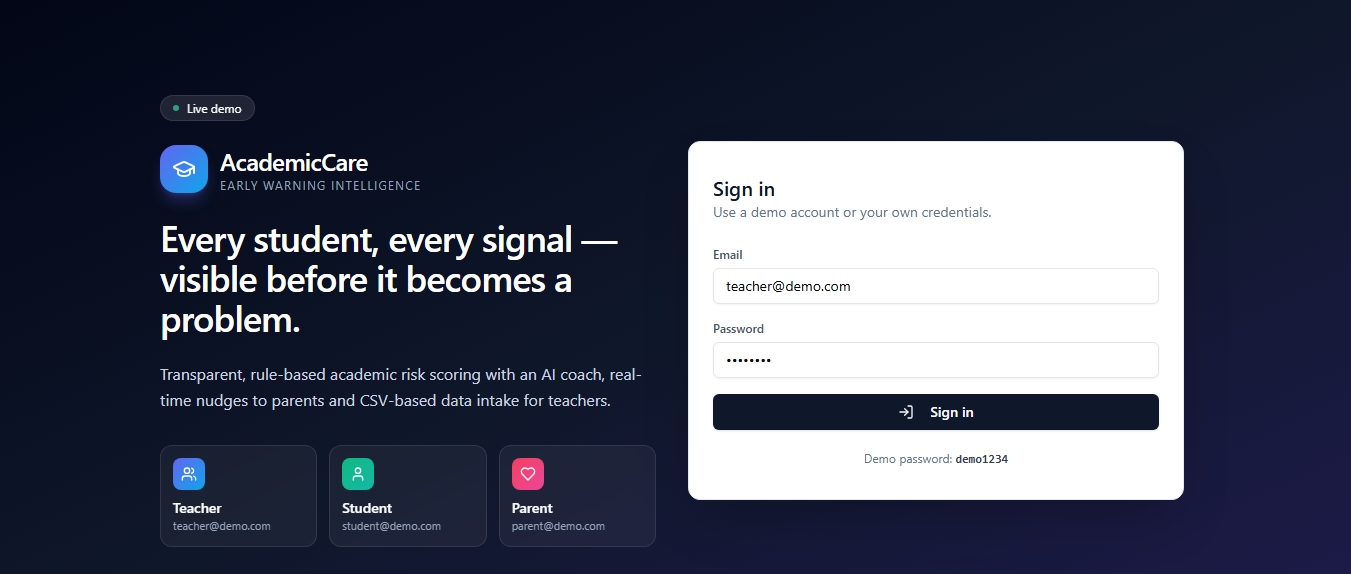
Students: Receive academic insights, identify weak subjects/topics, and obtain personalized study guidance.
-
Teachers: Receive information about students requiring attention and can initiate academic interventions.
-
Parents: Receive relevant academic progress information, notifications, and reminders.
The prototype uses synthetic/generated student data rather than real student records. Therefore, it demonstrates the system architecture and workflow but does not claim that its predictive performance has been institutionally validated.
Related Work
Previous research in Educational Data Mining (EDM) and Learning Analytics has demonstrated that student activity and academic data can be analyzed to identify learning patterns and students who may need support. Academic analytics and early-warning systems have similarly shown the value of converting institutional data into actionable information.
However, Academic Care extends these ideas by integrating risk identification, weak-area analysis, personalized guidance, teacher intervention, parent communication, and progress monitoring into one workflow. The system also considers privacy and ethical requirements because academic data can contain sensitive student information.
Methodology
The system follows several major stages:
-
Data Handling: Student information can be provided through structured data such as CSV files. Synthetic data are currently used for development.
-
Risk Detection: A deterministic, rule-based mechanism calculates an academic risk score and assigns a risk classification.
-
Weak-Area Identification: The system determines which subjects or topics require additional attention.
-
AI-Assisted Guidance: AI uses student context, risk information, and weak areas to provide explanations and personalized study plans.
-
Intervention: Teachers can initiate support actions, parents can receive relevant notifications, and student progress can be monitored.
An important design principle is that AI does not independently decide whether a student is academically at risk. Instead, the transparent rule-based system generates the risk signal, while AI is used mainly for explanations, conversational assistance, and personalized study planning.
Technology and Architecture
Academic Care uses a layered architecture consisting of:
-
Data collection
-
Student data management
-
Analytics and risk detection
-
Weak-area analysis
-
Intervention
-
Role-based presentation
The prototype uses MongoDB as the core database and JWT-based authentication with role-based access control. Separate experiences are provided for students, teachers, and parents to help prevent inappropriate access to information.
Conclusion
Academic Care presents a working prototype for AI-assisted academic early warning and student intervention. The system addresses the gap between academic information and actionable support by connecting risk classification, weak-area identification, personalized study planning, teacher intervention, parent notifications, and progress tracking within a single workflow. The architecture combines a transparent rule-based risk mechanism with AI-assisted explanation and personalization. This separation allows the risk signal to remain deterministic while using AI to support human-readable guidance and study planning. The current prototype demonstrates the feasibility of the proposed software architecture and stakeholder workflow. Student, teacher, and parent dashboards, risk classification, risk scoring, weak-area identification, AI study assistance, personalized study plans, teacher intervention, parent nudges, CSV import, JWT authentication, analytics, and feedback/progress tracking are implemented. At the same time, the project has important boundaries. The prototype uses synthetic/generated data, and attendance, assignment, and marks/test tracking are not currently implemented as standalone modules. More importantly, the current evidence does not provide validated predictive or intervention-performance metrics. Therefore, the work should be understood as an engineering prototype rather than a validated institutional prediction system. The next research stage should focus on reproducible evaluation using appropriately governed real-world or anonymized academic data, transparent documentation of the risk engine, measurement of predictive performance, evaluation of AI-generated study plans, and assessment of intervention effectiveness. The central contribution of Academic Care is consequently not an unsupported claim of predictive accuracy, but an integrated architecture that connects academic risk detection to understandable, personalized, and stakeholder-oriented intervention.
References
[1] R. S. Baker and P. S. B. Inventado, “Educational data mining and learning analytics,” in Learning Analytics: From Research to Practice, J. A. Larusson and B. White, Eds. New York, NY, USA: Springer, 2014, pp. 61–75, doi: 10.1007/978-1-4614-3305-7_4. [2] C. Romero and S. Ventura, “Educational data mining: A review of the state of the art,” IEEE Transactions on Systems, Man, and Cybernetics, Part C (Applications and Reviews), vol. 40, no. 6, pp. 601–618, 2010, doi: 10.1109/TSMCC.2010.2053532. [3] J. P. Campbell, P. B. DeBlois, and D. G. Oblinger, “Academic analytics: A new tool for a new era,” EDUCAUSE Review, vol. 42, no. 4, pp. 40–57, 2007. [4] L. P. Macfadyen and S. Dawson, “Mining LMS data to develop an ‘early warning system’ for educators: A proof of concept,” Computers & Education, vol. 54, no. 2, pp. 588–599, 2010, doi: 10.1016/j.compedu.2009.09.008. [5] A. Pardo and G. Siemens, “Ethical and privacy principles for learning analytics,” British Journal of Educational Technology, vol. 45, no. 3, pp. 438–450, 2014, doi: 10.1111/bjet.12152. [6] A. H. Reshmi, J. S. Saini, S. M. Ahemad, S. J. Warhokar, and A. V. Ladi, “Academic Care: AI-Powered Early Warning and Intervention System for Student Academic Support,” Team Cognivance project documentation, G H Raisoni Skill Tech University, Nagpur, India, 2026. [7] A. H. Reshmi, J. S. Saini, S. M. Ahemad, S. J. Warhokar, and A. V. Ladi, “Academic Care: Visual Project Documentation,” Team Cognivance, G H Raisoni Skill Tech University, Nagpur, India, 2026. [8] Team Cognivance, “Academic-Care-V0.2,” Academic Care source repository, 2026.
Copyright
Copyright © 2026 Prof. Shraddha Raut, Ammar Husain Reshmi, Jaskaran Singh Saini, Shakib Mumtaj Ahemad, Swayam Jaykumar Warhokar, Ayush Vijay Ladi. This is an open access article distributed under the Creative Commons Attribution License, which permits unrestricted use, distribution, and reproduction in any medium, provided the original work is properly cited.
Download Paper
Paper Id : IJRASET85057
Publish Date : 2026-10-04
ISSN : 2321-9653
Publisher Name : IJRASET
DOI Link : Click Here
 Submit Paper Online